The music
The bandoneón and its band
The instruments behind a tango night: the bandoneón's odd keyboard, the violins, piano and bass, the singer, and how the sextet grew into an orquesta típica.
Look for an open date ↗Quick answer
The sound of tango rests on the bandoneón, a concertina whose buttons give different notes on the push and the pull. Around it stand violins, piano and double bass, the core of the sextet that Vicente Greco is credited with standardising. A larger orquesta típica adds strings and bandoneóns, and a singer may join. No line-up is promised for any show, but knowing these parts helps you hear what is going on.
A German instrument in Argentina
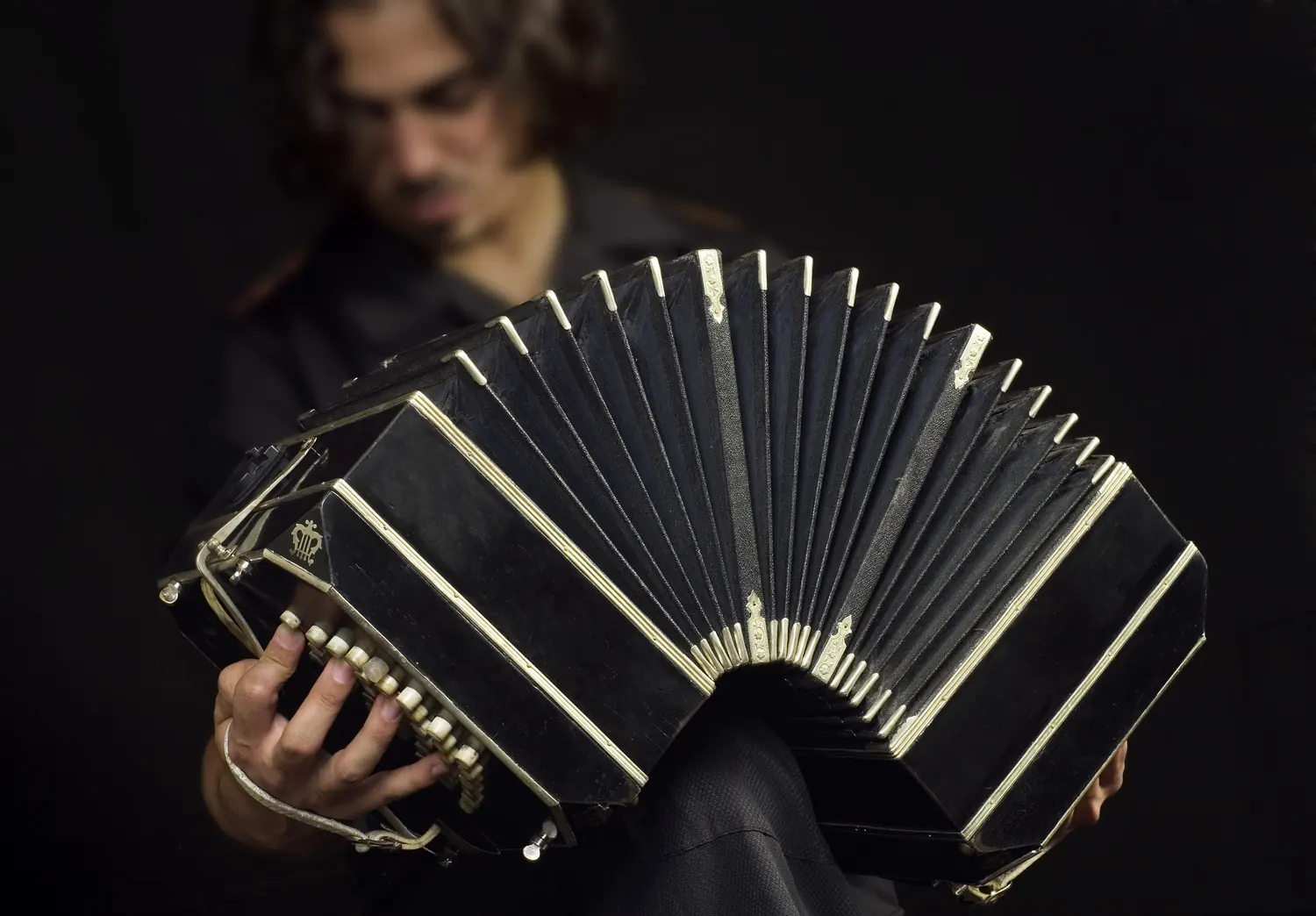
The bandonion takes its name from Heinrich Band, a German instrument dealer, and it was first intended for religious and popular music of its day. It is thought to have crossed to Argentina around 1870 with sailors and emigrants from Germany and Italy, though no documents show exactly how it arrived. By 1910, bandoneons were being made in Germany expressly for the Argentine and Uruguayan markets. Historically they were produced mainly in Germany and never in Argentina, which is a curious fact about the instrument most closely tied to the city's music.
Why it is so hard to play
Like other concertinas, it sits between the hands and pushes air through tuned metal reeds. The trouble is that a given button produces one note on the push and another on the pull, and the two hands have different layouts. That leaves the player with four separate keyboards to learn. Many tango players avoid some of this by working almost entirely on the pull, using an air-release button to close the bellows quickly. The two sides differ in tone as well: nasal and muted on the left, bright and sharp on the right.
From trio to sextet
The first generation of players in Buenos Aires, known as the Guardia Vieja, used portable instruments: flute, guitar and violin trios, with the bandoneón arriving at the end of the nineteenth century. Eduardo Arolas, nicknamed the tiger of the bandoneon, was the major driver of its popularity. Vicente Greco soon standardised the tango sextet: piano, double bass, a pair of violins and a pair of bandoneóns. In the 1920s, bandleaders such as Roberto Firpo and Francisco Canaro dropped the flute and added a double bass, and the music moved towards more respectable rooms.
The orquesta típica
In Argentina and Uruguay, the phrase orquesta típica means a tango band of a particular shape: a string section of three or four violins, sometimes with viola and cello, three or more bandoneons, and a rhythm section of piano and double bass. Golden Age bands, from about 1935 to 1952, often went beyond a dozen performers. A small room cannot hold that, which is worth remembering when you read about the great orchestras. Any café stage works on a smaller scale, and the line-up on your night is up to the people staging the show.
The singer steps forward
A tango can be purely instrumental or have a vocalist. Carlos Gardel, whom English Wikipedia calls the most prominent figure in the history of tango, helped develop tango canción in the 1920s. Lyrics are marked by nostalgia, sadness and laments for lost love. Later bands also worked with star vocalists: Aníbal Troilo's orchestra, known above all for its instrumentals, recorded with singers including Roberto Goyeneche and Edmundo Rivero. Gardel himself is listed among the café's visitors.
What to listen for
Start with the difference between the two hands of the bandoneón, then notice who holds the tune: the piano and bass keep the ground while strings and bellows trade the line. Listen for a change of pulse too. Tango runs in two or four, milonga sits quicker and lighter, and the tango waltz, or vals, rolls in three. Dancers respond to all of this, opening or closing the embrace as the music shifts. You do not have to name anything to enjoy it, but it gives your ears something to follow.
Who this isn't for
This page is background and not a programme note. If you want to know exactly which pieces and which players you will hear on a given night, nobody can tell you in advance, and this guide will not guess. If you want a full orchestra, look for a concert hall and not a café. And if you prefer your tango modern and experimental, ask yourself whether a programme of classics is what you came for. For the first-timer, though, the classics are precisely the right place to begin.
Sources